Rodent activity inside living spaces introduces severe psychological distress along with tangible biohazards, as active colonies soil structural framing and gnaw through high-voltage electrical wiring. In older…
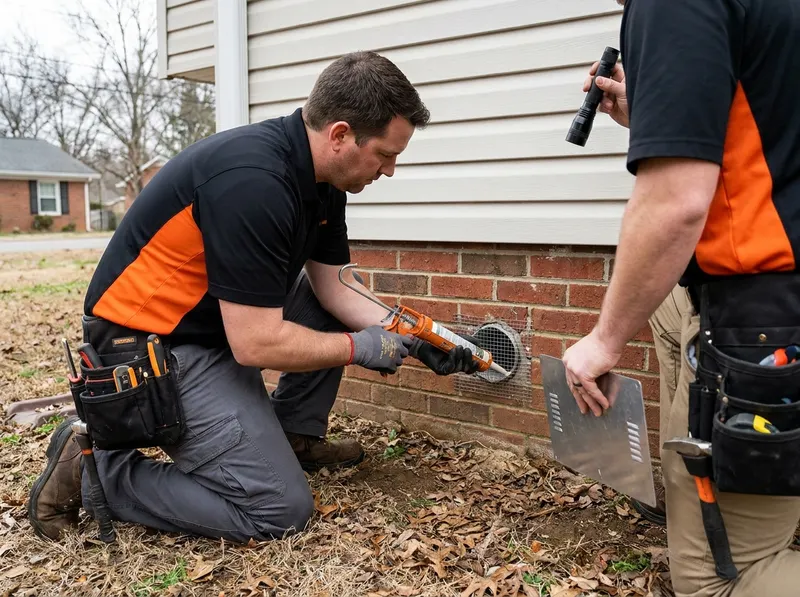
Rodent activity inside living spaces introduces severe psychological distress along with tangible biohazards, as active colonies soil structural framing and gnaw through high-voltage electrical wiring. In older residential enclaves such as East Nashville, Belmont-Hillsboro, and Germantown, stone-and-mortar foundations frequently yield structural settling gaps that roof rats exploit during seasonal temperature drops. Newly constructed dwellings in The Nations and 12 South face equal vulnerability where exterior plumbing penetrations or HVAC chase lines leave unsealed voids through exterior composite cladding. Implementing physical containment using 16-gauge galvanized steel hardware mesh, silicone-polyurethane sealants, and metal flashing eliminates access routes permanently, whereas hardware-store consumer rodenticides merely disperse toxic baits that risk secondary poisoning to non-target domestic animals as outlined by the U.S. Environmental Protection Agency.
Effective abatement shifts the biological dynamic of the structure through measured interventions verified by the Centers for Disease Control and Prevention. Commensal rodents require food, water, and harborage within a 100-foot foraging radius; properties bordering creek beds in Sylvan Park or dense vegetative corridors near the Shelby Bottoms Nature Center host sustained populations that migrate toward conditioned residential crawlspaces. Field protocols established by the Pest Control Technology Association emphasize that broadcast chemical applications inside living quarters create localized carcass decomposition risks inside wall cavities. Instead, mechanical snap devices deployed inside locked containment stations secure active adults while baseline exterior barriers cut off ingress routes. Crucially, a common non-obvious reality is that consumer bait boxes placed along external perimeter walls attract supplemental rodents into the yard unless every structural foundation opening smaller than 0.25 inches is mechanically closed first.
Structural remediation must address ambient humidity and subfloor integrity, particularly across flood-plain zones in Donelson and Hermitage where subterranean moisture compromises subfloor seals. Following standards defined by the National Pest Management Association, biological decontaminations require the extraction of nesting matrices, urine-saturated fiberglass batts, and pheromone trails using commercial HEPA negative-air equipment. Attic insulation abatement prevents airborne pathogen drift, aligning with property clearance metrics managed under Metro Public Health Department biological sanitation recommendations. Homeowners with finished basements in Green Hills or crawlspace foundations in Inglewood gain total stability through targeted architectural repairs rather than binding themselves to arbitrary multi-year service contracts.
Every remediation operates through a deliberate three-tier clinical protocol. First, an entry diagnosis traces every exterior-to-interior junction from foundation footings to roof ridge vents according to standards detailed by the U.S. Department of Housing and Urban Development. Second, exterior exclusion teams install rigid metal barriers and non-corrosive copper mesh around weeping vents, pipe escutcheons, and crawlspace doors. Third, enclosed interior snap grids clear trapped specimens, culminating in an enzymatic bio-wash to neutralize lingering rodent scents that draw outside cohorts. For rapid operational dispatch or direct diagnostic questions, contact GoldenArc Pest Experts at (629) 319-7848.
Every job gets a firm, written price after a free on-site visit.
Tell us about your rodent exclusion and abatement job in Nashville and we'll send a clear, written quote, usually the same day.
 GoldenArc Pest Experts