Active infestations inside sleeping quarters interrupt rest and create immediate physical distress for families across Middle Tennessee. GoldenArc Pest Experts deploys forced-air convective heating units that elevate…
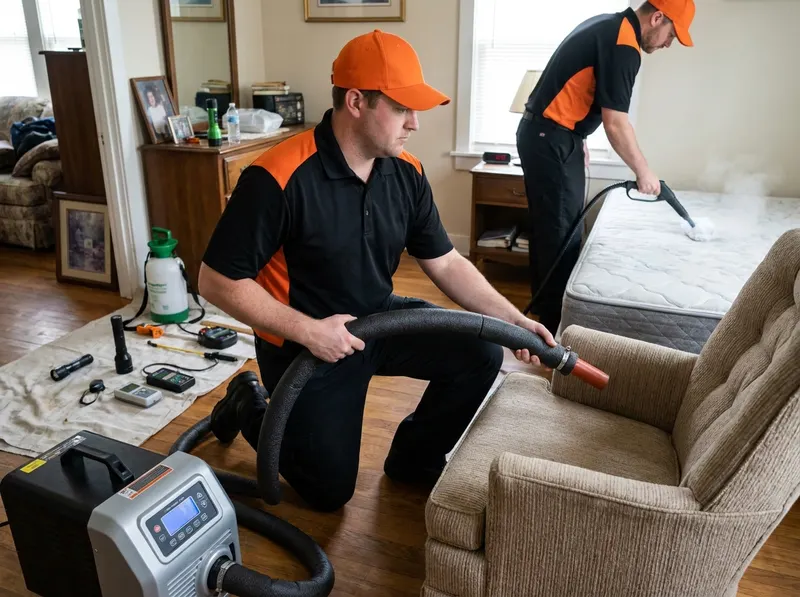
Active infestations inside sleeping quarters interrupt rest and create immediate physical distress for families across Middle Tennessee. GoldenArc Pest Experts deploys forced-air convective heating units that elevate ambient room temperatures to a lethal threshold of 122°F to 135°F, following parameters set by the United States Environmental Protection Agency. According to research published by the Journal of Economic Entomology, sustained exposure to 120°F kills adult bed bugs and desorbs moisture from viable eggs within 20 minutes. Forced air circulates into mattress seams, baseboards, and wall voids throughout older framed properties in Belmont-Hillsboro, 12 South, and East Nashville where structural settling creates expansive nesting harborages. Our technicians verify thermal penetration using multi-sensor infrared telemetry across cold spots before concluding the cycle.
Thermal remediation resolves active harbourages, but pairing heat with physical contact applications establishes persistent perimeter security. The protocol pairs heat with targeted applications of non-repellent formulations governed by the Tennessee Department of Agriculture to intercept wandering nymphs. Technicians apply amorphous silica dust, verified under Occupational Safety and Health Administration chemical guidelines, inside electrical switch plates and plumbing chases near wet walls. Homeowners often weigh localized contact sprays against whole-room heat. While direct sprays target visible insects on headboards, thermal convection moves through floorboard gaps and lathe-and-plaster assemblies common in Germantown and Sylvan Park, ensuring unexposed nymphs cannot survive behind insulation.
Preparing a residence requires methodical structural clearing rather than complex chemical washing. 1. Remove meltable items including wax candles, oil paintings, prescription medications, and vinyl records from the treatment footprint. 2. Launder bedding and clothing at water temperatures exceeding 120°F, following textile standards outlined by the American Society for Testing and Materials, and seal clean garments into clear airtight bags. 3. Technicians stage commercial electric and indirect-fired heaters, positioning circulating fans to direct airflow under heavy furniture. 4. Post-treatment HEPA extraction removes desiccated insect remains from mattress folds and carpet tack strips, following filtration standards from the National Institute of Environmental Health Sciences. 5. Precision dust barriers are injected into perimeter baseboard joints to protect adjoining bedrooms against migrating insects.
High-density housing developments along the Cumberland River in The Nations and Donelson present continuous structural transit pathways through common utility risers. GoldenArc Pest Experts installs insect interceptor monitors under bed legs to document zero movement, aligning with monitoring benchmarks from the Entomological Society of America. Building structures near moisture-heavy zones like Inglewood, Hermitage, and Green Hills benefit from targeted moisture remediation, as ambient indoor humidity above 55% preserves pest vitality. The integration of continuous structural monitoring via guidelines from the Centers for Disease Control and Prevention guarantees comprehensive resolution without locking property owners into unnecessary 12-month recurring treatment contracts.
Every job gets a firm, written price after a free on-site visit.
Tell us about your bed bug thermal and contact eradication job in Nashville and we'll send a clear, written quote, usually the same day.
 GoldenArc Pest Experts