Powderpost beetle larvae from the Lyctidae and Anobiidae families feed on the starch within hardwoods and softwoods, systematically tunneling through floor joists and load-bearing sills until the inner timber degrades…
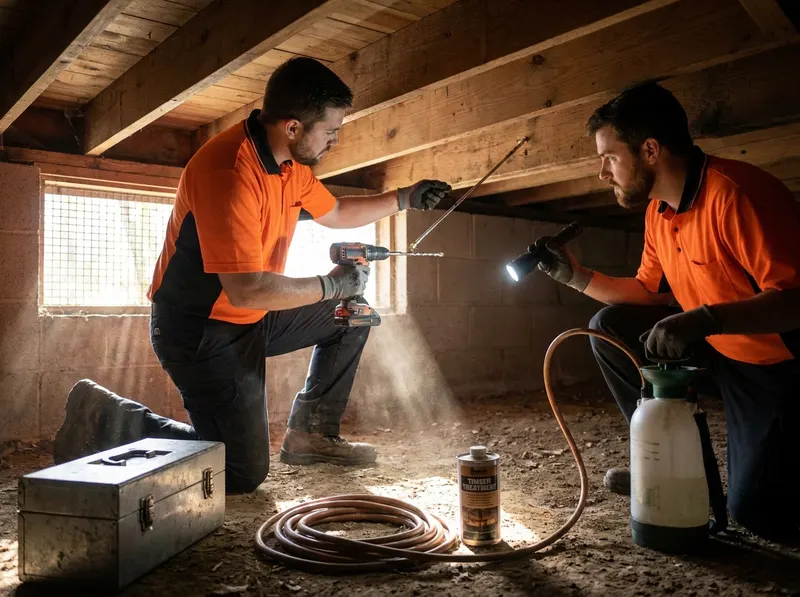
Powderpost beetle larvae from the Lyctidae and Anobiidae families feed on the starch within hardwoods and softwoods, systematically tunneling through floor joists and load-bearing sills until the inner timber degrades into a fine, flour-like powder. In Middle Tennessee, structural infestations concentrate heavily in crawl spaces and basements where subfloor moisture levels exceed 14 percent, a common condition across older historic foundations in Belmont-Hillsboro, 12 South, and Germantown. The Tennessee Department of Agriculture Regulatory Services governs the application of wood-destroying organism treatments, requiring precise formulation mixing to arrest larval development inside subterranean framing. When timber moisture climbs above 18 percent, frequently detected in shaded, low-lying parcels near Radnor Lake State Park and the clay-heavy soils of Donelson, Anobiid beetles deposit eggs directly inside unsealed surface pores, allowing larvae to bore inward unnoticed for two to five years before emergence holes appear.
Remediation success hinges on pairing direct wood-infusing chemistry with aggressive microclimate management. Applying topical aerosol cans from big-box retailers fails because surface residues do not penetrate the necessary 0.25 to 0.5 inches into dense structural lumber where mature larvae feed. GoldenArc Pest Experts uses soluble borates that bond directly to the cellulose fiber, remaining active inside the dry wood matrix for decades. Guided by research from the University of Tennessee Agricultural Extension Service and the USDA Forest Service Southern Research Station, treatments require bare wood substrates; sealed, painted, or heavily mold-encrusted joists must first be cleaned or wire-brushed to permit liquid uptake. According to structural pest guidelines outlined by the US Environmental Protection Agency and standards published by the National Pest Management Association, wood with active infestations must be treated with sufficient solution volume to achieve structural saturation without pooling in the crawl space dirt.
High relative humidity across Davidson County accelerates timber reinfestation. Properties near water bodies such as Shelby Bottoms Greenway in East Nashville or the Cumberland River loop through Inglewood regularly register ambient crawl space humidity above 75 percent during summer months. In accordance with residential ventilation guidelines from the US Department of Housing and Urban Development and building safety criteria tracked by the International Code Council, lowering timber moisture below 12 percent effectively halts juvenile larval digestion. While minor localized infestations can be resolved with focused spot applications starting at the $150 minimum, broader structural infestations in Sylvan Park and The Nations often require 10-mil ground vapor retarders alongside industrial dehumidification aligned with the American Society of Heating, Refrigerating and Air-Conditioning Engineers standards. Safe indoor chemical handling protocols established by the National Institute for Occupational Safety and Health protect living quarters above treated areas, providing durable, documented protection without forcing families into recurring multi-year contracts.
Every job gets a firm, written price after a free on-site visit.
Tell us about your powderpost beetle timber treatment job in Nashville and we'll send a clear, written quote, usually the same day.
 GoldenArc Pest Experts